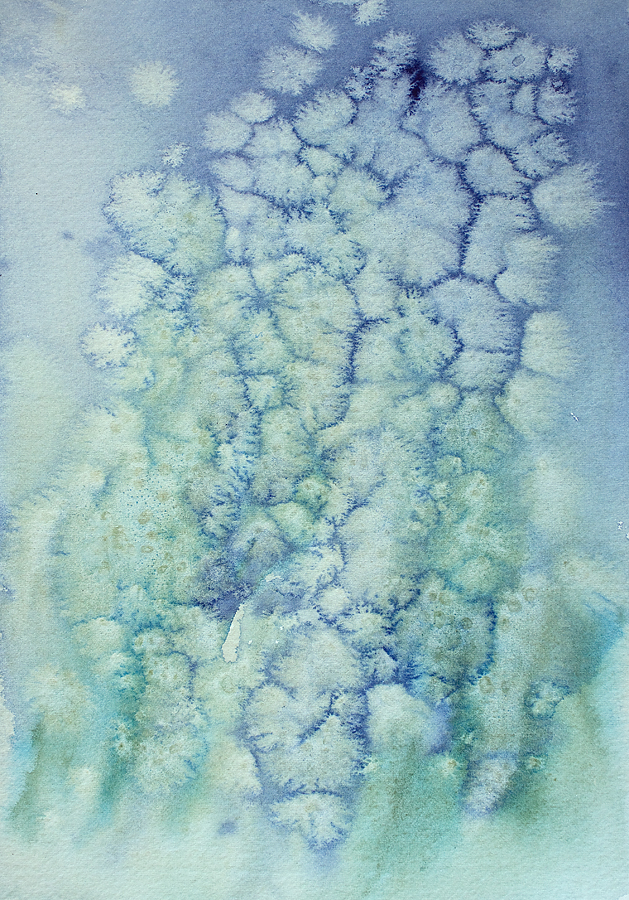
Above are some awesome salt patterns I created. The colours I used for this wash were Indanthrone Blue and Cascade Green by Daniel Smith. The Salt I used was a coarse grain sea salt.
Creating salt patterns in watercolour is never going to be an exact science but I have found that when creating salt patterns it helps to know the properties of your paints – ie. whether they are Transparent, Semi-transparent, Semi-opaque or Opaque. The transparent paints generally create good salt patterns because they are made up of finer particles that move more readily across the paper. Opaque, Semi-opaque and some of the more heavily granulating paints are made up of heavier particles that don’t move so quickly across the paper – these are much less likely to create very good salt patterns. Also, a coarse/larger grained salt will generally create larger patterns than a fine salt. So it’s good to consider what effects you would like to achieve and then choose your salt type accordingly.
In my wash above the Indanthrone Blue is a transparent paint – hence it has created really good salt patterns. The Cascade Green, however, is made up of two colours – Phthalo Blue GS (transparent) and Raw Sienna, (granulating). The Phthalo Blue part of the Cascade Green has created some salt patterns but the Raw Sienna part less so, probably because of it’s granulating property. So overall the Cascade Green has produced much more subtle salt patterns.
Something else to consider when creating salt patterns, is the type of paper you are using. Cold pressed paper is smoother and allows the paint to move more freely across the paper and creates salt patterns more easily; but a rough surface paper will slow down the movement of the paint and makes creating salt patterns more challenging!
You do need to add the salt to the paint at the right time. If the surface of the paint is very shiny, then it may be too wet. Wait till the shine has gone off a bit, so the paint is still damp but not too wet.
Using salt with watercolour is a very old technique but it’s still a lot of fun and great for creating textural effects. Why not give it a go… ?
 INDIGO BEACH ART
1 Comment