Watercolour is a beautiful transparent medium. But not all watercolour shades are fully Transparent (T) – some are Semi Transparent (ST), Semi Opaque (SO) or Opaque (O). It’s important for me to know this information about my watercolours because it will affect the way the colours behave on the paper when painting. So, I decided to test out some of my colours to see how transparent they really are:
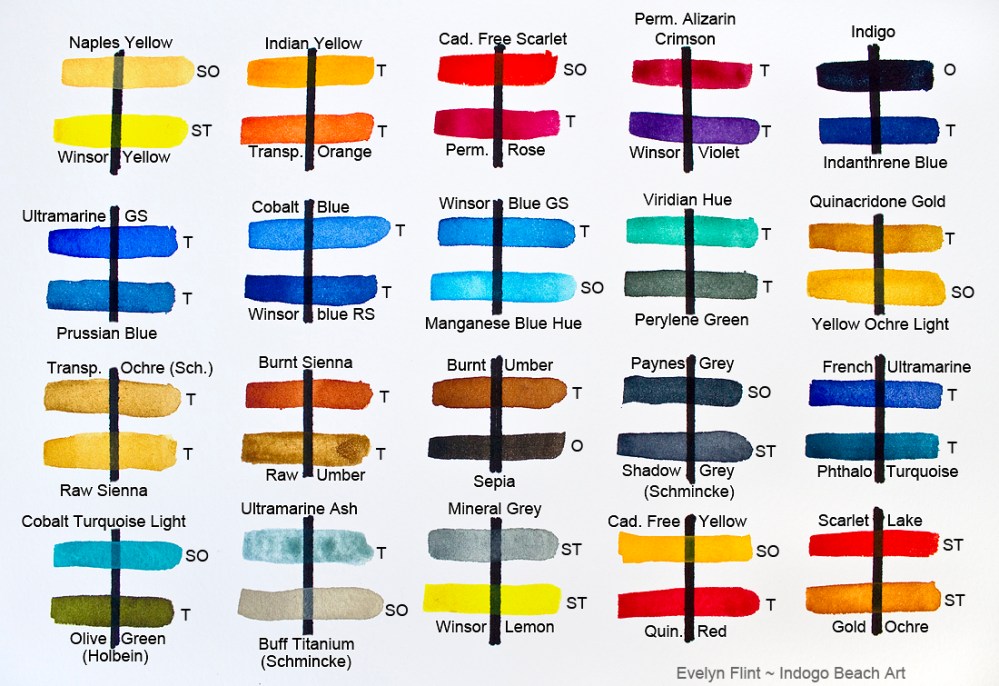
Above I tested 40 colours – the 28 colours in my palette, plus 14 others just to fill up the paper; all colours are Winsor & Newton unless otherwise stated. I used Arches Cold Pressed watercolour paper and began by making vertical black lines with a black Sharpie pen which is permanent and waterproof. Then painted my colour samples, in a single layer, over the top and I was fairly generous with the paint to maximize their covering power.
Now for the results… !! The colours I knew to be transparent (all Winsor & Newton) performed exactly as I expected – they are absolutely Transparent, which makes me very happy. But some of the Semi Transparent colours surprised me… but in a good way; Indanthrene Blue, Cobalt Blue and Olive Green are classed as Semi Transparent by their respective manufacturers, but from my tests above I’m quite happy to regard these 3 colours as Transparent! I wasn’t expecting that! Another surprise in the Semi Transparent range was Winsor Yellow – it’s only just in the Semi Transparent range and is very very close to the Transparent end of the opacity scale… that pleases me too!
A few more surprises… !! Naples Yellow, Cadmium Free Scarlet and Cadmium Free Yellow are all classed as Opaque by Winsor & Newton, but from my experiments above I would definitely put them in the Semi Opaque category. I’m completely OK with that. My next happy surprise was Payne’s Gray… it’s Semi Opaque still but definitely edging towards the Semi Transparent side of the opacity scale, not quite as opaque as I thought it would be and I would say the same for Yellow Ochre Light too… interesting! Finally, in my colour samples above, I only have two colours that I regard as fully opaque – Indigo and Sepia. And I love them! They are beautiful colours!
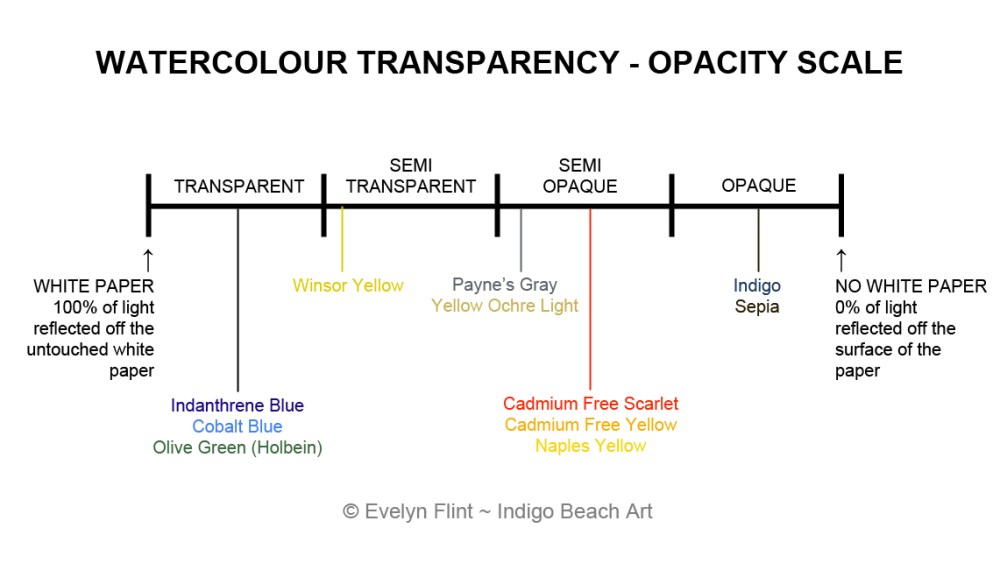
I created the diagram above to illustrate how I view transparency/opacity in watercolour. On the far left of the scale is the pure white paper, which reflects the maximum amount of light. On the far right of the scale is where fully opaque paint prevents light being reflected off the surface of the paper. And all watercolours will fit somewhere in between these two extremes. Transparent watercolours allow the most amount of light to be reflected off the surface of the paper through transparent layers of watercolour paint, creating radiant paintings; Opaque watercolours allow the least amount of light to be reflected off the surface of the watercolour paper. Of course, a very thin/dilute layer of Opaque watercolour will be transparent… and likewise, a very thick layer of Transparent watercolour will be more Opaque.
In conclcusion: It’s always a good idea to take note of the information supplied by watercolour manufacturers about their watercolours. But, ultimately, I feel it’s better to test them out for yourself and make your own judgements about them! I’m very happy with all of the colours in my palette and wouldn’t change any of them. There were no unpleasant surprises at all. And I love the high level of transparency in my Winsor & Newton Palette. Happy days! Why not test your watercolours out, and see what surprises you get!
Happy painting!

