Welcome to the new home for Indigo Beach Art!
This website is still under construction, but more content will be added over the coming weeks. Please feel free to LIKE, SUBSCRIBE, FOLLOW and COMMENT.
I hope you enjoy your visit here.
Evelyn
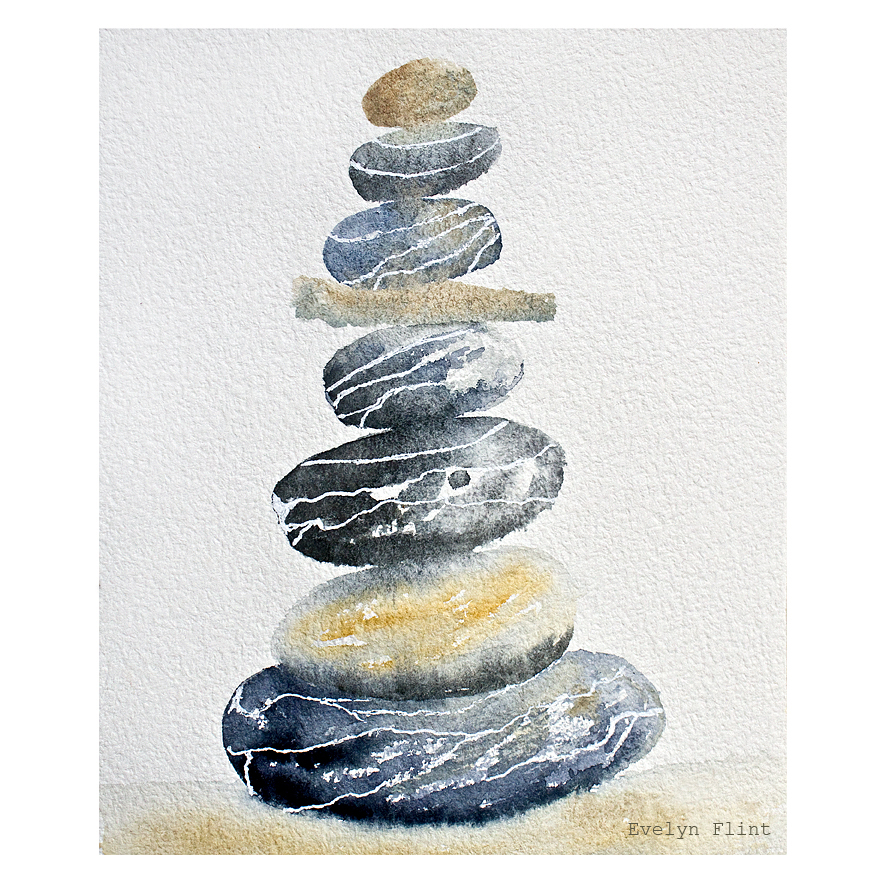
Exploring the beautiful world of watercolour…..
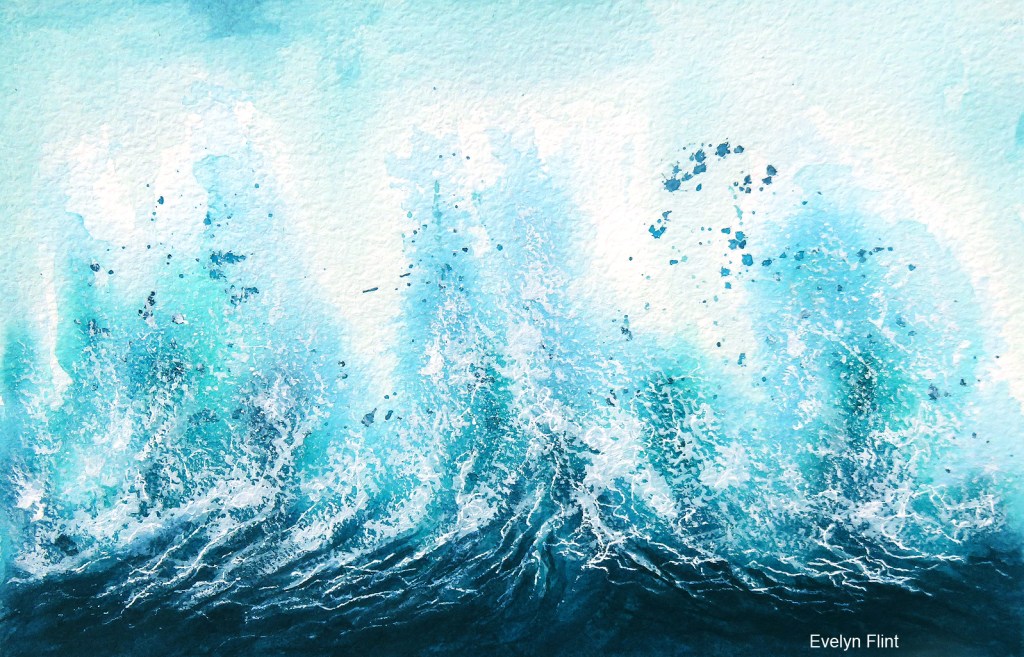
For the seascape above I started out with no agenda, I was just going to play with a few colours. I started out with Winsor & Newton’s Indigo and started painting from the top of the paper. I then used water from a spray bottle (not too much!!) to encourage it to run down the paper a little. I then added some Phthalo Blue Turquoise (DS) because it’s a colour that complements W/N Indigo perfectly. I then turned my paper “upside down” so the colours wouldn’t run down the paper too far, the paper being at a 45° angle. That was when I could see a seascape appearing…
I decided to “run” with the seascape idea. I added some Prussian Blue and some Ultramarine Turquoise, both by Daniel Smith. I added some more Indigo to create some darker tones and finished off with some W/N Titanium White for the sea spray.
It was painted on Baohong Master’s Choice rough paper and measures 15 x 23 cm. This will go into my sketchbook (with notes) for future inspiration. I may do something like this on a larger scale and maybe experiment with different colour combinations…
Next some sky practice inspired by Lois Davidson on YouTube…
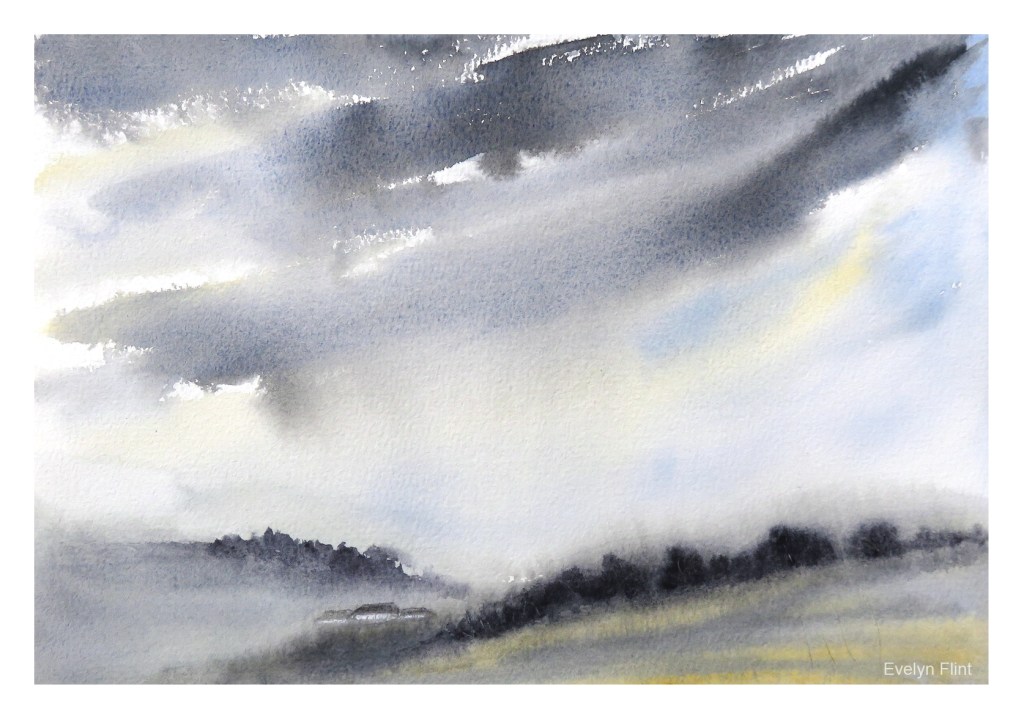
For the moody, stormy sky above I used Cotman Payne’s Grey, Ultramarine GS (W/N) and Raw Sienna Light (DS). I love Cotman’s Payne’s Grey – it’s transparent and I love how the colours separate out when you add lots of water to it. I added a very simple landscape to the bottom just to give some context for the sky. This will go into my sketchbook.
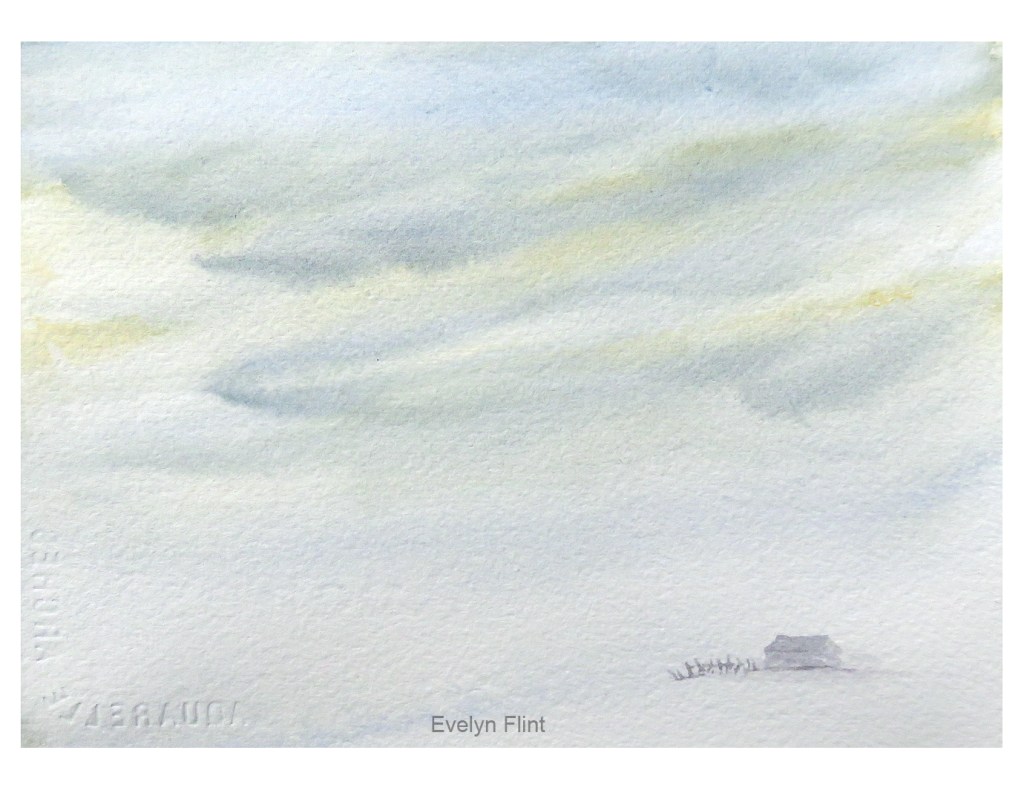
A very simple cool wintry sky above. I just used Ultramarine GS and Raw Sienna Light. I like how these two colours interact together. This sky lent itself to being a snow scene so I added a little building with a fence, to indicate it being surrounded by snow. Of course, this is not a finished painting – it’s just me putting ideas onto paper.
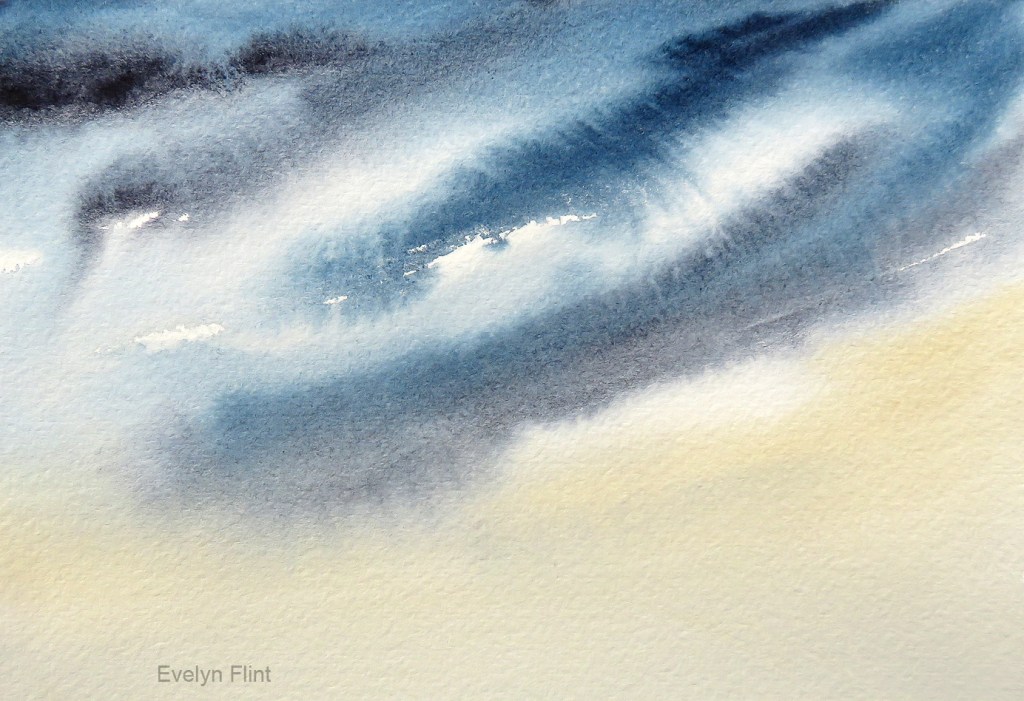
Another stormy sky above. For this I used W/N Indigo, Jane’s Grey and Raw Sienna Light. I tried to make sure I left some light areas in this sky. I’ve discovered that if you want white areas in a sky then it’s best to leave them white in the first place, rather than lifting out colour afterwards. It’s always very easy to add colour to a white area in a painting, but not so easy to lift it out afterwards… !
If you have a chance, please to take a look at Lois Davidson’s YouTube channel. There’s always lot’s of lovely, inspiring things to watch and learn from. At this point I will mention that, technically speaking, I now have a YouTube channel – which you can view HERE if you wish. BUT I have no intention of adding any videos! I created it so that if I decided to leave a comment on a YouTube video, then anyone reading the comment can view a page to find out a bit more about me and where I display my art. The only other thing you will see there are a few channels that I have decided to feature as these are the channels I visit most frequently on YouTube.
That’s all for now, and I hope you’re able to find time to do something creative today!
Learning about and understanding TONE is one of the most important things a watercolourist has to learn. It’s something that I’ve always been conscious of and I’ve tried to incorporate it into my watercolour painting with varying degrees of success (and failure!). But I’ve never made a proper study of tonal values until now…
I have been inspired to do this by a channel I found on YouTube – NVfineARTstudio. Nina Volk, the author of this channel, has published a brilliant video about tone – you can watch it HERE. I’m not going to explain anything about the video – you will have to watch it for yourself!
But this is what it inspired me to do….
Firstly, I was prompted to find this out from among my art supplies:
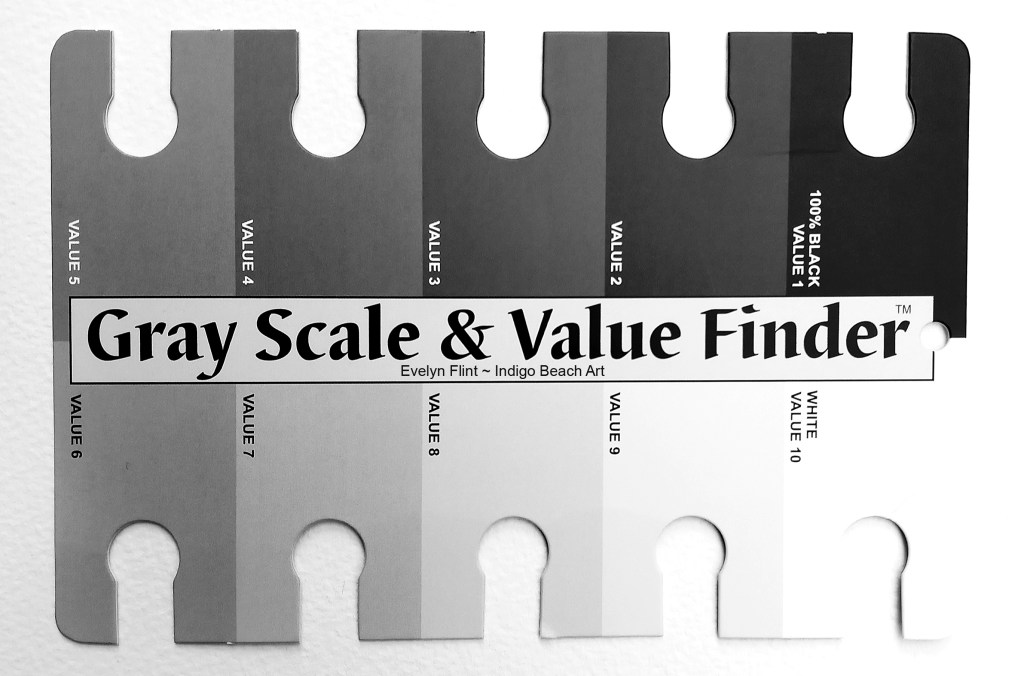
You’ve probably seen one of these before, or something similar. I bought this several years ago and I’ve never used it… until now! To be honest, I’ve never really understood how it works or what I’m supposed to do with it. Nina’s video changed all that!
Next I created my own Grey Scale/Value Finder in photoshop:
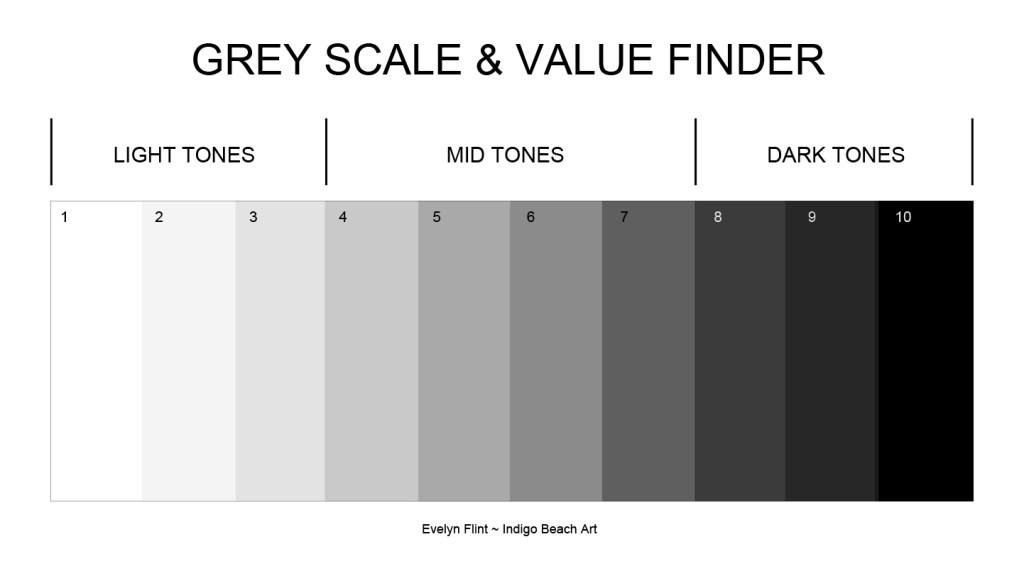
Notice that I have re-numbered the values on my Grey Scale chart so that the lightest value (white) is 1, which in watercolour represents the untouched white of the paper; and the darkest value is 10 which is black. Why did I change the numbers? Well, I’ve noticed a few other artists have done this and I like it – it seems a more logical approach to me. In watercolour we usually work from light to dark, so having 1 as the lightest value makes sense. So, values 1 – 3 are the light values, values 4 – 7 are the mid tones and values 8 – 10 are the darkest values.
What I need to know now is how these Grey Scale values relate to the colours in my palette. So I painted a few colours from my palette in different tones and compared them:
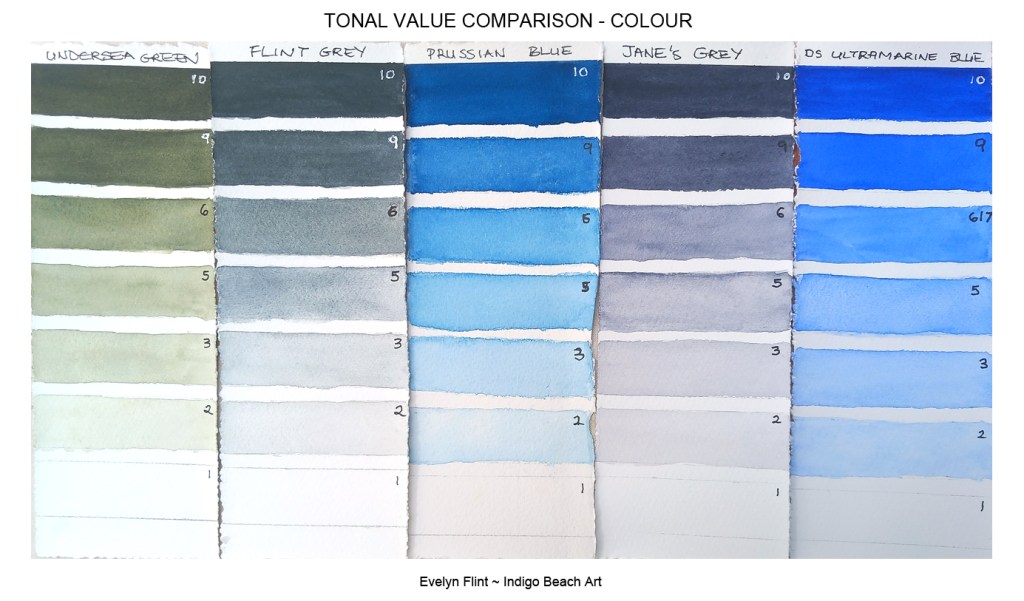
Above are five colours that I frequently use and I painted them in a range of tonal values – 2 dark tones (10 & 9), 2 mid tones (6 & 5), 2 light tones (3 & 2) and white (1) at the bottom. To make sure I got the tonal values consistent for each colour, I used the camera in my smart phone which I switched to greyscale. I then placed them side by side and converted them to greyscale and compared them:
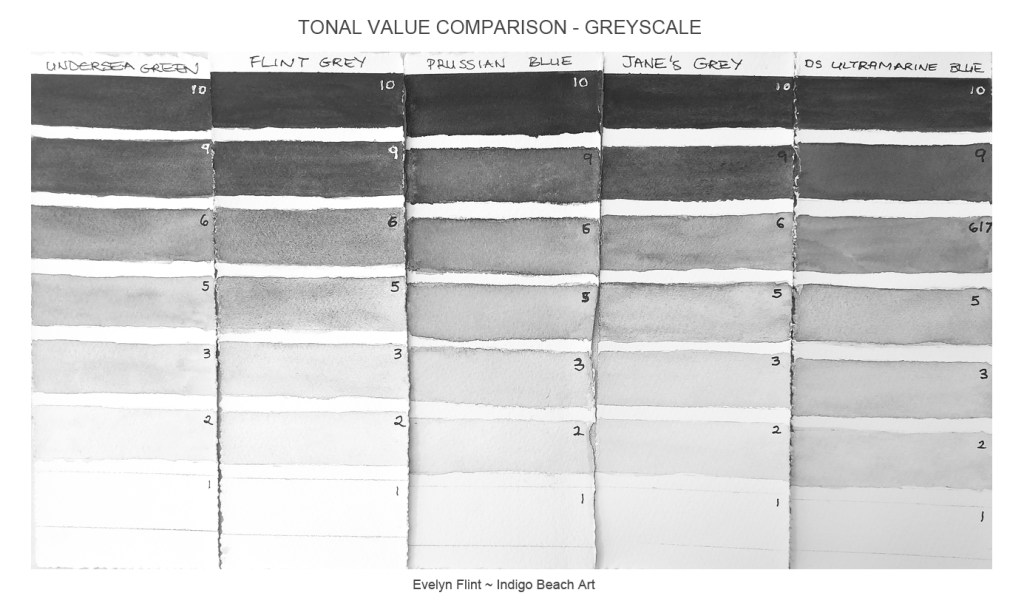
When you compare the different tones of each colour in the greyscale image above, notice how the tones are identical for each colour. I will keep these colour tone samples for future reference and I will probably create more for other colours in my palette. This has been a really useful exercise and I feel I already have a much better understanding of tonal value. In the colour comparison chart, when I compare the Undersea Green values 6 and 9 with the same Prussian Blue values, I would have said that the Undersea Green was darker; but when comparing them on the Greyscale chart, I can see that the tones are, in fact, identical!
I now realise I will have to learn the tonal values of ALL the colours in my studio palette; and learn how each one relates to the others….
The other tonal value exercise I did was this:
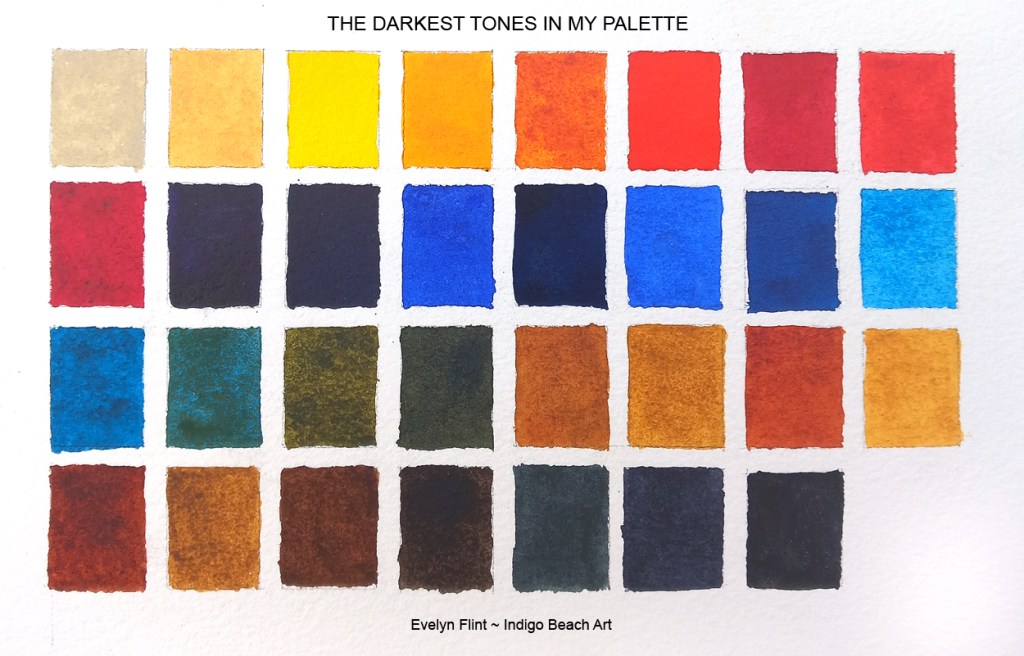
In the above colour chart, I painted all of the colours in my studio palette, 31 colours in total. I painted each one in the darkest possible value it would reach, almost neat pigment (but not quite!) and each colour was painted in only one layer. The colours are:
Top row, left to right: Buff Titanium, Naples Yellow, Hansa Yellow Medium, New Gamboge, Aussie Red Gold, Pyrrol Scarlet, Permanent Alizarin Crimson(W/N), Quinacridone Coral
2nd Row, left to right: Quinacridone Rose, Carbazole Violet, Indigo (W/N), Ultramarine Blue, Prussian Blue, Cobalt Blue, Phthalo Blue GS, Manganese Blue Hue
3rd Row, left to right: Phthalo Blue Turquoise, Cascade Green, Olive Green, Undersea Green, Quinacridone Gold, Monte Amiata Natural Sienna, Quinacridone Burnt Orange, Raw Sienna Light
4th Row, left to right: Transparent Red Oxide, Raw Umber (W/N), Burnt Umber, Sepia, Flint Grey, Jane’s Grey, Lunar Black
Next I converted these colour samples to greyscale:
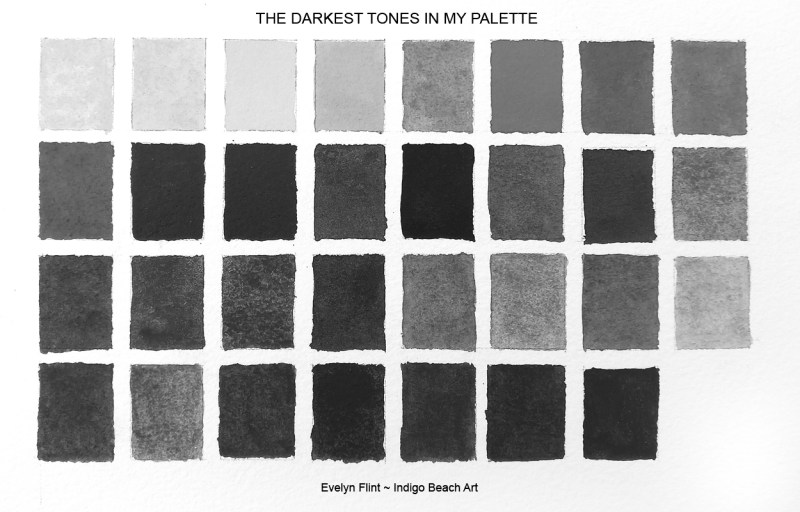
This greyscale conversion above tells me quite a lot about the colours in my palette.
The darkest tones above, value 8 – 10, like Indigo, Sepia, Jane’s Grey, Lunar Black, Prussian Blue, Ultramarine Blue, Flint Grey, Burnt Umber, Transparent Red Oxide, Undersea Green etc., are going to achieve the widest range of values from the very dark to very pale. They are extremely useful to the watercolourist.
The lightest tonal values above are the three colours on the left of the first row, namely, Buff Titanium, Naples Yellow and Hansa Yellow Medium. In this chart they are only a tonal value of 4. If I painted a second layer of colour they might reach a value of 5. BUT they wont reach a higher or darker value than this. I could paint 20 layers of Buff Titanium and it wont go beyond a tonal value of 5 !! This means that in a painting, colours with a low tonal value range will need the support of other colours with a much higher tonal range. This also means that when I choose to paint with a limited palette, I need to make sure the colours I choose will, collectively, reach all the tonal values I need.
In conclusion, I would say that this has been a time consuming but very helpful set of watercolour exercises. I now have a much better understanding of tonal value. But I do need to learn more! However, I am spurred on by what I’ve learnt from this and will endeavour to keep moving forward in my watercolour journey.
That’s all for now, happy painting!

 INDIGO BEACH ART